The Aerogramme
How a folded sheet of paper outran balloons, biplanes, and the entire internet, then quietly vanished from the world.
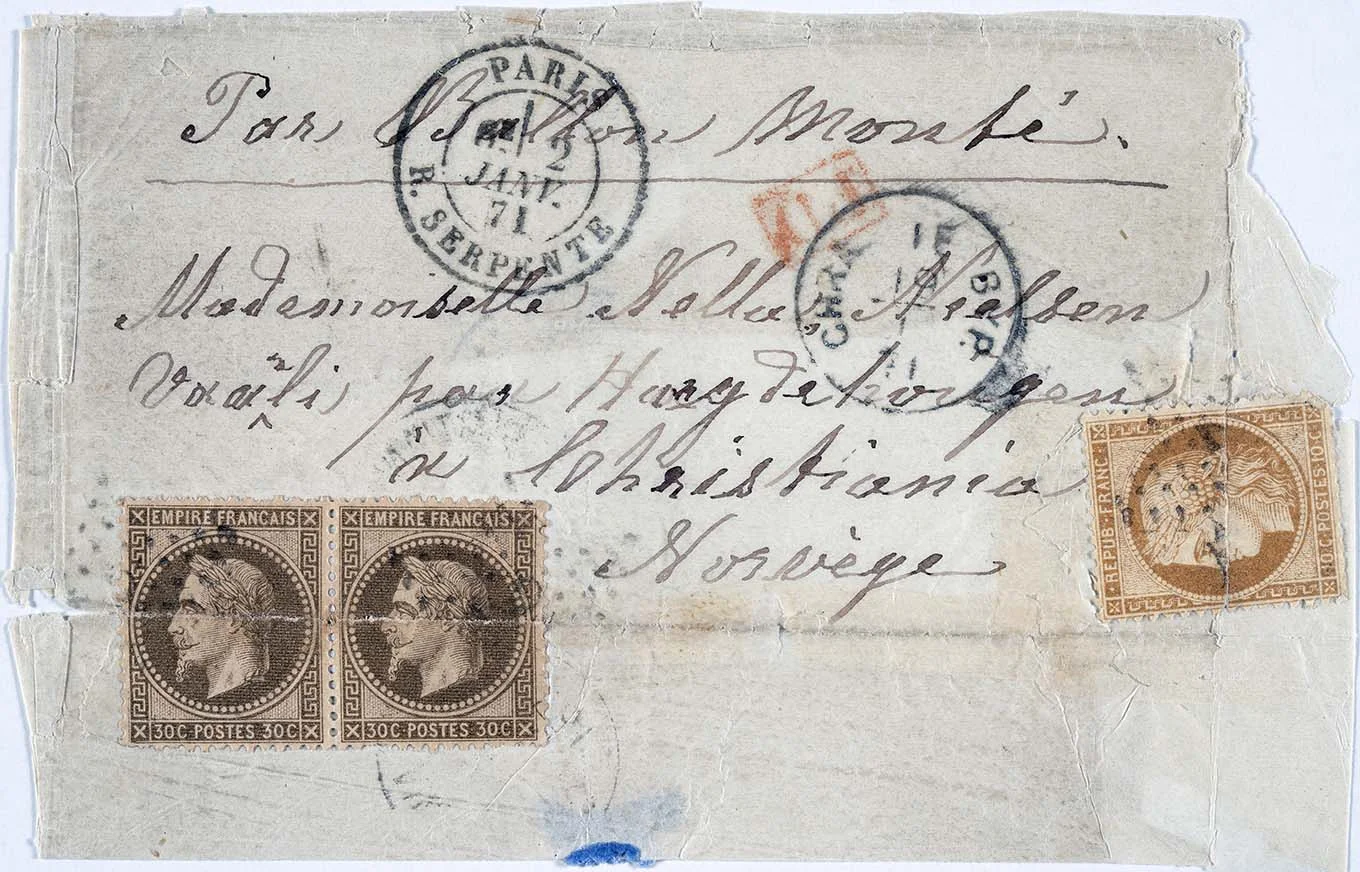
A real “Par Ballon Monté” letter, posted from Paris in January 1871 during the siege, addressed all the way to Christiania (Oslo), Norway. Franked with Empire Français stamps.
It began with a siege, a balloon, and a very specific kind of desperation.
Paris, September 1870. The Prussian army had encircled the city. No trains in or out. No telegraph lines. Half a million soldiers, two million civilians, and no way to tell anyone on the outside that you were alive.
So they used balloons. Actual, gas-filled balloons, launched from the Gare du Nord and the Gare d'Orléans, drifting over Prussian lines at night, carrying sacks of mail and the occasional government official. Sixty-seven balloons launched during the siege. Fifty-five made it. The rest landed in the sea, in enemy territory, or, in one famous case, in Norway.
The man who set it in motion was Nadar, the celebrated portrait photographer, who raised a company of balloonists almost overnight. With the railways strangled by the siege, two dead stations became factories. At the Gare du Nord, Nadar's crew stitched their envelopes by machine; at the Gare d'Orléans, the Godard brothers ran a workshop where roughly a hundred women sewed the fabric by hand, seam by seam, under a Madame Godard. The first of these balloons, the Neptune, lifted from the butte of Montmartre on 23 September 1870 and cleared the Prussian lines. The air post was born.
All told, sixty-five manned balloons rose out of Paris during the siege, carrying more than two million letters, each one weighed and rationed to a few grams. They carried people, too: a hundred and sixty-four of them escaped the city that way, among them the minister Léon Gambetta, who drifted out over the enemy lines to raise an army in the provinces. The balloons only ever went out; the return was left to pigeons. Each bird came home with a tiny tube lashed to its tail feather, holding thousands of dispatches shrunk onto microfilm, read at journey's end by projecting them onto a screen.
And when nothing could fly at all, Parisians tried the river. Mail was sealed inside zinc spheres, the “Boules de Moulins,” and floated down the Seine toward the city, to be caught in a net strung across the water. Fifty-five were released. Not one reached Paris before the siege broke. Some were pulled from the riverbed decades later, still heavy with letters that never arrived.
It was during this chaos that someone had a quiet, practical idea. What if the letter didn't need an envelope? What if you just wrote on a single sheet, folded it into itself, and sealed it shut? Lighter paper meant more letters per balloon. More letters per balloon meant more people who could say what needed saying before it was too late.
These improvised air letters, inscribed “Par Ballon Monté,” carried patriotic slogans in both French and German along their borders. They weren't official or sanctioned. Private printers made them, printers who understood that when the world closes in, people will pay anything to send a few sentences to someone they love.
“Sixty-seven balloons launched over Prussian lines. Fifty-five arrived. Every one of them carried letters that someone wasn't sure would ever be read.”
It would take another seventy years for anyone to revisit the idea. But the seed was there, floating over enemy lines in a wicker basket at 3,000 feet: the notion that a letter and its envelope could be one and the same thing, and that this small compression could matter enormously.
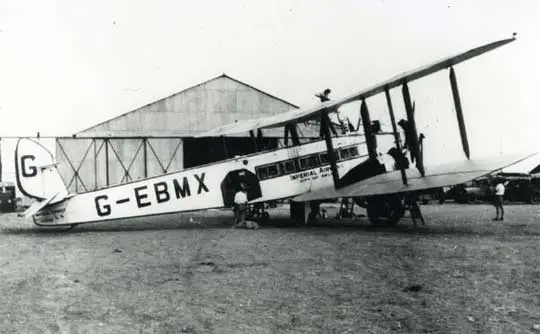
A De Havilland Hercules (G-EBMX) of Imperial Airways on the Cairo–Baghdad route, c. 1926. Pilots navigated by following furrows ploughed into the desert by tractors.
Then came the biplanes, the desert routes, and navigation by railway.
On 25 August 1919, a single-engine plane took off from Hounslow Heath with one passenger and a sack of mail, and landed in Paris two and a half hours later. This was the first regular daily international air passenger service in the world. The pilot navigated by looking for railway lines and reading town names painted on station roofs. Forced landings were not infrequent.
Commercial aviation in those years was held together with canvas, ambition, and government subsidies. In 1924, Imperial Airways was formed with fifteen assorted aeroplanes and a grant of one million pounds to, as the official language put it, “help it off the ground.” Their first routes were weekly services to Paris, Brussels, Amsterdam, Berlin, and Cologne.
The longer routes were the interesting ones. Cairo to Baghdad, pioneered by the RAF, was taken over by Imperial Airways in December 1926. Air navigation across featureless desert was essentially impossible, so they sent convoys of cars to mark out a visible track on the ground. In particularly difficult areas, a tractor ploughed a deep furrow in the sand. Emergency landing grounds were prepared every twenty miles. The pilot of the Handley Page biplane “City of Baghdad” followed these furrows the way you'd follow a motorway today, except the motorway was scratched into the Mesopotamian desert by a farmer's tractor.
All of this mattered because each flight carried mail. And the heavier the mail, the less fuel you could carry, and the fewer emergency landing strips you could skip. Weight was everything. Paper was the enemy.
Here's the part everyone forgets: for the first few decades, mail is what paid for flight. Planes couldn't carry enough passengers to turn a profit, so it was the letters that kept the airlines alive. Governments, chasing their colonies, covered the rest. In 1918 a French outfit called Latécoère (later the Aéropostale) began flying sacks of mail from Toulouse to Madrid, then down to Dakar, where the letters were loaded onto boats bound for South America. The men who flew those routes (Mermoz, Guillaumet, a quiet pilot named Antoine de Saint-Exupéry) crossed deserts and the Andes and went down in storms, and some of them died, for a cargo of other people's letters. Saint-Exupéry got a whole book out of those nights. The mail was worth dying for. That tells you something.
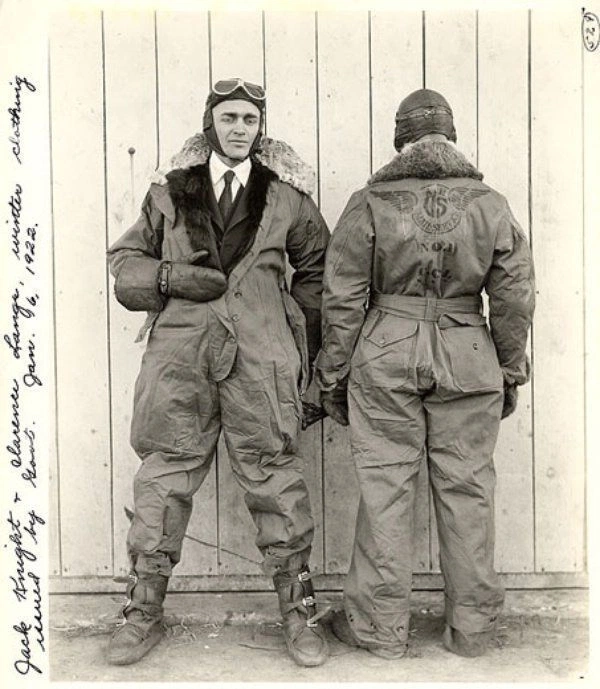
Winter flying kit issued to U.S. Air Mail pilots, January 1922: fleece-lined leather, helmet and goggles against the cold of an open cockpit. On the left, Jack Knight, who flew the first night leg of transcontinental airmail.
They flew in open cockpits, wrapped in fleece-lined leather against a cold that could fall to thirty below. No radio, no radar: a compass, a map, and their own nerve. They looked less like airline captains than like deep-sea divers, and half the job was simply surviving the weather long enough to hand off the mail.
The lengths people went to are almost comic. To shave a day or two off the Atlantic crossing, German engineers built seaplanes that were catapulted off the deck of a ship in the middle of the ocean, flung into the air like a stone from a sling, so that a bag of letters could reach New York twenty hours sooner.
And once the aircraft finally grew big enough, the letters flew in style. The Boeing 314 Clipper that Pan Am put over the Atlantic in 1938 had seventy-four seats that folded into forty bunks, and served six-course dinners at altitude. All of it (the linen, the berths, the dinners) was built around the same humble thing: getting a written page from one hand into another.
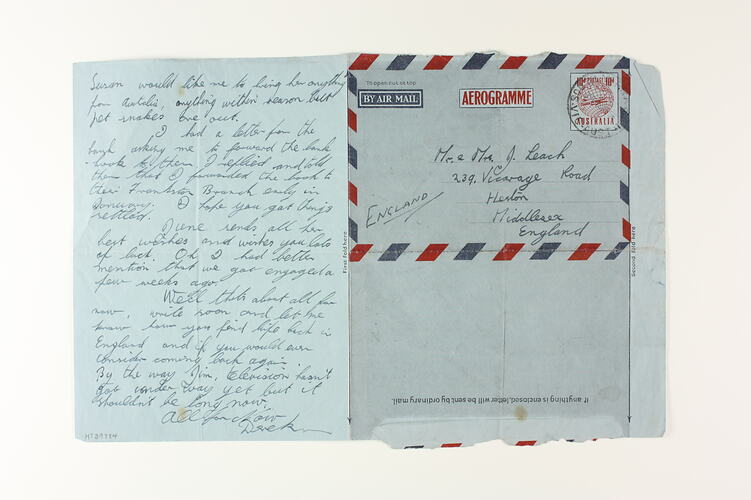
An aerogramme, unfolded. One sheet of lightweight blue paper that is its own envelope: the address on the outside, the whole letter on the inside. This one flew by air from Australia to a family in Middlesex, England.
Then came another war, and the idea finally clicked.
By 1941, Britain had hundreds of thousands of troops stationed overseas. They all wanted to write home. Their families all wanted to write back. Reasonable enough. The trouble was that conventional letters (paper, envelope, additional sheets) were heavy. Heavy things didn't fly cheaply. There was a war on. Fuel was rationed. Aircraft capacity was limited. And morale, the generals had noticed, was dropping.
Someone at the General Post Office remembered the Paris balloon letters and had an updated version of the same thought: what if the letter was the envelope? One sheet of lightweight paper, pre-stamped, folded into thirds, sealed with a lick. No envelope needed. No extra weight. You could fit thousands into a mail sack that used to hold hundreds.
They called it an “air letter.” It cost threepence. Soldiers wrote on the inside, both sides if they could manage the space, folded it along the printed lines, licked the gummed edge, and handed it in. The recipient back home tore along the perforated edge and unfolded it. That was the whole technology. No machinery, no infrastructure, no app store. Just paper, folded cleverly.
It worked so well that after the war, nobody stopped using it. The Universal Postal Union adopted the format in 1952 and gave it a proper name: aerogramme. From the Greek: aero (air) and gramma (letter, or written thing). Every member country was encouraged to produce them, and nearly all of them did.
“The aerogramme was the original compression algorithm. Fold the medium into the message. Send more meaning in less weight.”
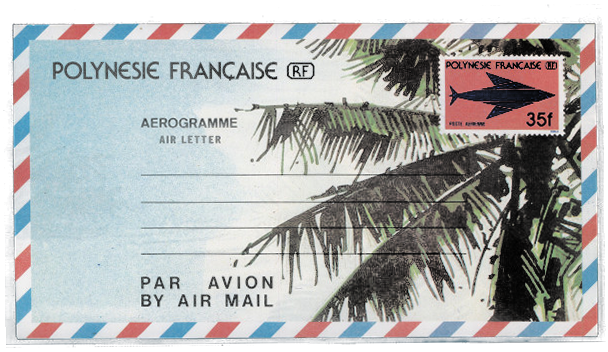
Every country designed its own. This one, from French Polynesia, came printed with palm trees and a 35-franc fish. India's cost 10 paise; the UK's flew anywhere in the world for the price of a domestic stamp.
For forty years, this is how the regular world stayed in touch.
The aerogramme was not a rich person's medium. It was a migrant worker's medium. A student abroad. A grandmother in a village writing to a grandchild in a city she'd never visit. An engineer on a contract in the Gulf, writing home to Lagos every Sunday evening.
In India, an inland letter cost 10 paise, a fraction of a fraction of a rupee. In the UK, an air letter to anywhere in the world cost the same as a first-class domestic stamp. The postal service subsidised the difference because they understood, in a way we've since forgotten, that keeping people connected is infrastructure, not a luxury.
And the format itself forced a kind of honesty. You had one sheet. Both sides, if your handwriting was small enough. That was it. No room for filler, no space for polite nothings. People wrote tighter. They thought harder about what to say. When your father sent you an aerogramme, every sentence was chosen, not because he was a good writer but because there was a physical limit to how many sentences would fit, and he didn't want to waste any of them on weather.
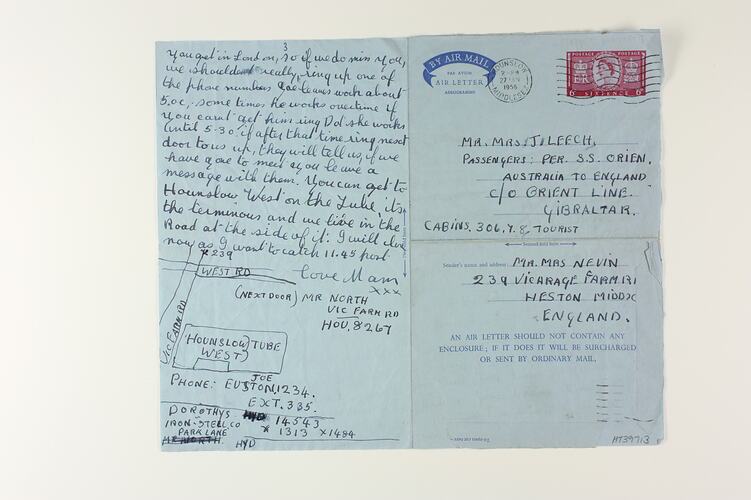
Heston, Middlesex, 1956. A mother writes to her family, passengers aboard an Orient liner, caught at Gibraltar. Phone numbers, a Tube station, "Love Mam." Every millimetre used; the last lines squeezed into the margin.
Then email arrived, and nobody said goodbye.
The aerogramme didn't die dramatically. There was no final edition, no commemorative ceremony. Countries just quietly stopped printing them. The UK discontinued theirs in 2012. India (which tells you something about India and something about letters) held on until 2017. The US Postal Service stopped in 2006. By then, hardly anyone noticed.
What replaced it wasn't better. It was faster, obviously. Email, then text messages, then WhatsApp, then voice notes recorded while driving. The content got shorter. The frequency got higher. The emotional weight of each individual message approached zero. And somewhere in that transition, we lost the thing that actually made a letter worth receiving: the fact that someone sat down, chose their words, and decided you were worth thirty minutes of their undivided attention.
A WhatsApp message takes three seconds. An aerogramme took half an hour. That gap isn't inefficiency. It's the entire point.
“Nobody frames a text message. Nobody keeps a voice note in a shoebox under their bed for forty years. But people kept aerogrammes. People kept every single one.”
Because the aerogramme was never just a postal format. It was an artifact of human connection: physical proof that someone, somewhere, sat down and decided that another person, somewhere else entirely, needed to hear from them. Every crease, every smudged word was evidence that the distance between two people had been bridged, however briefly, by a sheet of paper and a threepenny stamp.
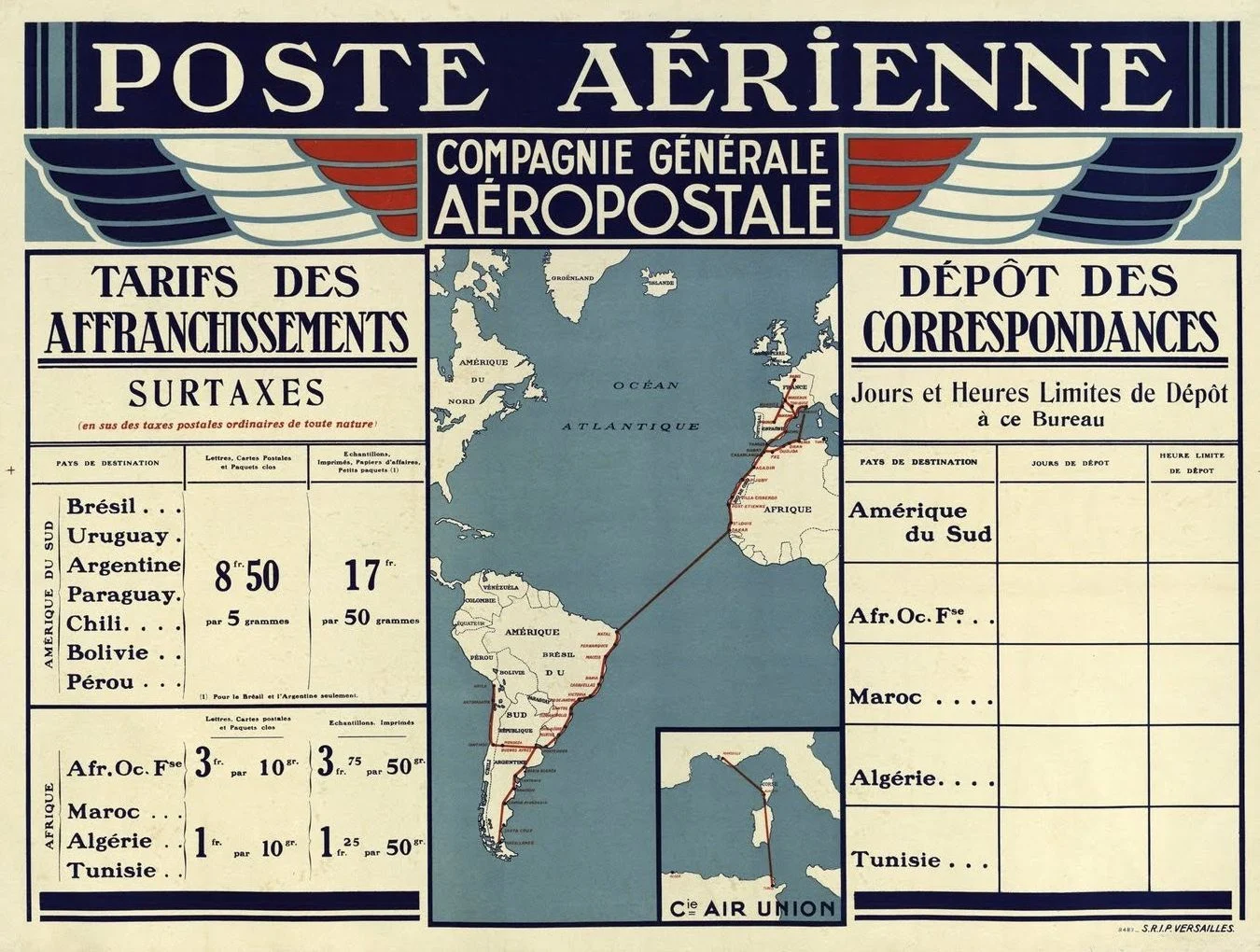
Compagnie Générale Aéropostale, c. 1930. Eight francs fifty per five grams to South America. The red line leaves France, follows the African coast to Dakar, then leaps the Atlantic to Natal, the route Mermoz, Guillaumet and Saint-Exupéry opened to carry the mail.
So why bring it back now?
Because now is exactly when you'd need one.
We live in the most connected period in human history. We have never been worse at making people feel remembered. Those two facts are related.
The problem with digital communication isn't that it's digital. It's that it costs nothing, not money and not effort. When something costs nothing to send, it communicates nothing about how much you care. The medium is the message, McLuhan said, and the message of a WhatsApp text is: “this took me three seconds, and I was probably looking at something else while I typed it.”
A letter says the opposite. A letter says: I stopped. I thought about you specifically. I chose these words, and not other words. I wrote them down on a thing that exists in the physical world, and I put it in motion toward you. That sequence of decisions is the message. The words inside are almost secondary.
How it works now.
We kept the spirit. We updated the process. You don't need to find a post office or buy a stamp or look up an international postage rate. You just need to know what you want to say and who should read it.
You message us on WhatsApp. We ask you a few questions. You tell us the recipient, the message, and whether you'd like us to pick the stamp or if you have a preference. We print it on quality paper, stamp it, and drop it in the post from France.
It arrives in five to fourteen days, depending on where in the world it's headed. That slowness is the whole architecture, not a bug. The anticipation, the surprise, the fact that it shows up between a gas bill and a flyer and stops someone on their doorstep: that's what makes it work.
One letter. 6.90 €. Anywhere in the world. No account, no app, no subscription.
Because some people deserve more than a blue tick.
Ready to send one?
Message us on WhatsApp